

Astronomer Highlight: Dr. Kate Minker
When you ask an astronomer when their interest in the field began, they will usually tell you a story about a time they looked up at the cosmos: perhaps the first time they saw a shooting star or looked through a telescope. In the case of Percival Lowell Postdoctoral Fellow and planetary astronomer Dr. Kate Minker, the interest that would eventually bring her to pursuing astronomy as a career began with looking down at Earth. “When I was three or four, I went to a botanical garden and I was enthralled,” Minker recalls. “I was like, I’m gonna work here when I grow up.” Her mother informed her that the job she was describing was called landscape design, and for many years, that was the plan. But eventually, her love of math began to pull her in a different direction. “I wanted to find something that was very mathy, but still related to natural science,” Minker explains. Eventually, she’d find that her two loves existed together in a single field.
According to Minker, there are two types of astronomers: those who were drawn to the field by a love of science fiction, and those who were drawn by a love of natural science.
“I’m very far on the natural sciences interest side,” she says. For Minker, space has always been an extension of the same curiosity that drew her to gardens as a child, but on a much larger scale. “I basically switched from “down” science to “up” science,” she says with a laugh.
Minker earned an undergraduate degree in astronomy and a creative writing certification from the University of Maryland, where she started out pursuing both physics and astronomy simultaneously. She had satisfied the requirements for a bachelors in astronomy by her third year, and decided to finish the degree early. The way her program was structured, there was a stretch of several semesters where astronomy classes were largely absent from her schedule, replaced by physics coursework that, at the time, didn’t align with her interests.
“I was thinking I was going to go into high school teaching,” she says. Then two things happened at once: she took a planetary science class she loved, and COVID arrived. The pandemic scrambled her plans for teaching as schools switched to online classes. She turned down a job offer at a boarding school and applied for a master’s program at the Université Côte d’Azur in Nice, France, co-hosted by the Observatoire de la Côte d’Azur, one of the world’s premier planetary science institutions. This program would also allow her to spend some time at the Royal Observatory of Belgium in Brussels.
When the opportunity came to stay at Côte d’Azur for her PhD on a related project, she took it. The work eventually took her even further afield, including a stint at the European Southern Observatory (ESO) in Santiago, Chile. “I kept loving it,” she says simply, “and I’ve been doing it ever since.”
At Lowell Observatory, Minker studies binary asteroid systems, or asteroids that have a smaller companion object orbiting them, using some of the most powerful telescopes on Earth. A technique called adaptive-optics imaging corrects for the blurring effect of Earth’s atmosphere to produce images that are, as Minker puts it, “as zoomed-in as possible,” in order to see the shape of the asteroid and the movements of its moon.
“Because the asteroid isn’t a sphere, the distribution of mass in that weird shape will add a little bit of extra movement to the orbit,” she explains. “You can track that, and it’s predictable to a certain level. And then you can see: is the perturbation we expect from the shape the same as the one we observe, or is there more or less?”
Imagine a large metal ball surrounded by a thick shell of Styrofoam, shaped like an egg. If you’re holding the egg at one end but the metal is at the other, the weight distribution is going to be uneven in a very specific, detectable way. This is essentially what Minker is doing: figuring out whether the mass inside an asteroid is distributed evenly throughout, or concentrated in one spot, and what that information can tell her about its history and composition.
“You know how much it weighs,” she says, “but is that weight distributed all the way through, or is it concentrated in one spot? And if it’s concentrated in one spot, what can we learn from that?”
Understanding the internal structure of these objects helps scientists understand the building blocks of the solar system, and ultimately, how planets like Earth came to be. As Minker points out, “Earth rocks are still space rocks. We just have a much better look at them.”
Kate uses several major facilities around the world in her studies (SPHERE at the Very Large Telescope in Chile, SHARK at the Large Binocular Telescope in Tucson to name two). Locally, she uses the Lowell Discovery Telescope is especially well-suited for tracking moving objects like asteroids, and the QWSSI speckle interferometry instrument allows her to speedily hunt for undiscovered asteroid moons.
Minker’s favorite part of her work is experiencing the moment of first light on a new object, and the satisfying immediacy that comes with imaging-based science. “As soon as you get the first images, you get some idea of what it’s gonna look like,” she says. “You don’t have to tease things out over time.”
When it comes to planetary science as a whole, she notes that it has a rare quality that sets it apart from almost every other branch of astronomy. “You could go there and check,” she says. Space missions, past and future, can offer insights that most astronomers never get. “It’s nice that there is a real, up close and personal comparison that you can anchor everything to.”
However, when asked if she would ever consider going into space herself, she had this to say: “Absolutely not. I love Earth. I want to stay right here.”
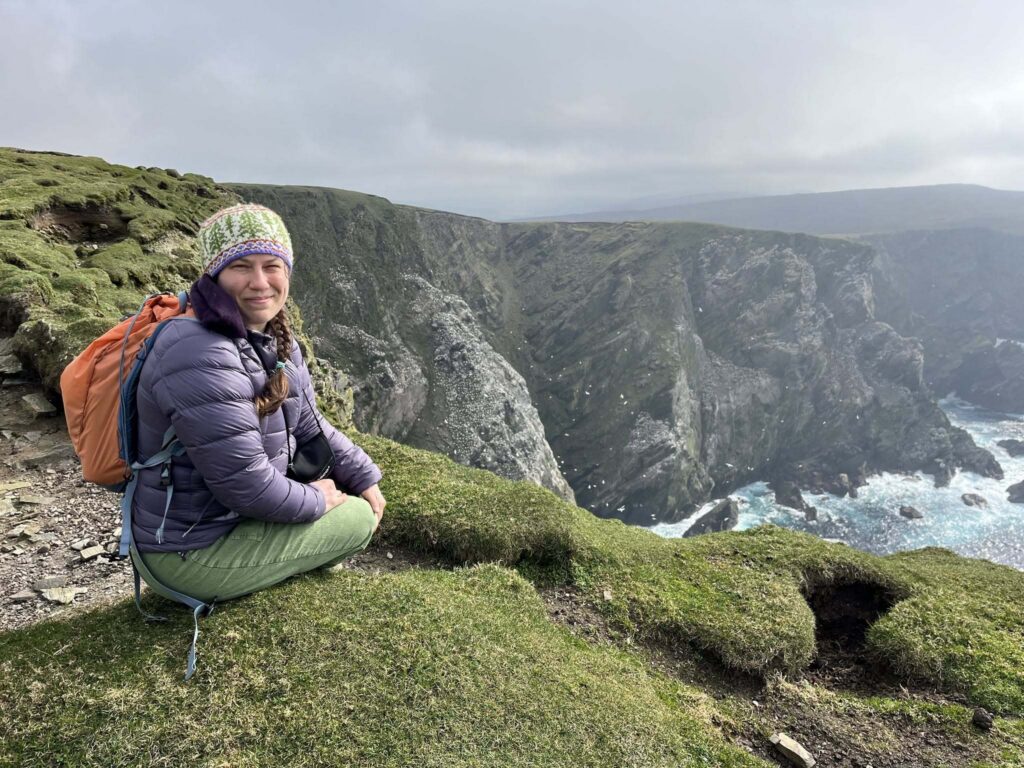
Outside of work, Minker does a little bit of everything. She knits, sews, dabbles in bookbinding, hikes, and recently, has started taking aerial silks classes.
Her favorite asteroid is (283) Emma, a large asteroid with what Minker describes as a particularly beautiful moon. Because asteroid Emma predates her friend and asteroid moon-hunting colleague Emma Mirizio by roughly a century, Minker often has to make a distinction between the two in conversation. The asteroid is Emma, and her colleague is “Human Emma.”
“I wanted to find something that was very mathy, but still related to natural science,” Minker explains. Eventually, she’d find that her two loves existed together in a single field.
According to Minker, there are two types of astronomers: those who were drawn to the field by a love of science fiction, and those who were drawn by a love of natural science.
“I’m very far on the natural sciences interest side,” she says. For Minker, space has always been an extension of the same curiosity that drew her to gardens as a child, but on a much larger scale. “I basically switched from “down” science to “up” science,” she says with a laugh.
Minker earned an undergraduate degree in astronomy and a creative writing certification from the University of Maryland, where she started out pursuing both physics and astronomy simultaneously. She had satisfied the requirements for a bachelors in astronomy by her third year, and decided to finish the degree early. The way her program was structured, there was a stretch of several semesters where astronomy classes were largely absent from her schedule, replaced by physics coursework that, at the time, didn’t align with her interests.
“I was thinking I was going to go into high school teaching,” she says. Then two things happened at once: she took a planetary science class she loved, and COVID arrived. The pandemic scrambled her plans for teaching as schools switched to online classes. She turned down a job offer at a boarding school and applied for a master’s program at the Université Côte d’Azur in Nice, France, co-hosted by the Observatoire de la Côte d’Azur, one of the world’s premier planetary science institutions. This program would also allow her to spend some time at the Royal Observatory of Belgium in Brussels.
When the opportunity came to stay at Côte d’Azur for her PhD on a related project, she took it. The work eventually took her even further afield, including a stint at the European Southern Observatory (ESO) in Santiago, Chile. “I kept loving it,” she says simply, “and I’ve been doing it ever since.”
At Lowell Observatory, Minker studies binary asteroid systems, or asteroids that have a smaller companion object orbiting them, using some of the most powerful telescopes on Earth. A technique called adaptive-optics imaging corrects for the blurring effect of Earth’s atmosphere to produce images that are, as Minker puts it, “as zoomed-in as possible,” in order to see the shape of the asteroid and the movements of its moon.
“Because the asteroid isn’t a sphere, the distribution of mass in that weird shape will add a little bit of extra movement to the orbit,” she explains. “You can track that, and it’s predictable to a certain level. And then you can see: is the perturbation we expect from the shape the same as the one we observe, or is there more or less?”
Imagine a large metal ball surrounded by a thick shell of Styrofoam, shaped like an egg. If you’re holding the egg at one end but the metal is at the other, the weight distribution is going to be uneven in a very specific, detectable way. This is essentially what Minker is doing: figuring out whether the mass inside an asteroid is distributed evenly throughout, or concentrated in one spot, and what that information can tell her about its history and composition.
“You know how much it weighs,” she says, “but is that weight distributed all the way through, or is it concentrated in one spot? And if it’s concentrated in one spot, what can we learn from that?”
Understanding the internal structure of these objects helps scientists understand the building blocks of the solar system, and ultimately, how planets like Earth came to be. As Minker points out, “Earth rocks are still space rocks. We just have a much better look at them.”
Kate uses several major facilities around the world in her studies (SPHERE at the Very Large Telescope in Chile, SHARK at the Large Binocular Telescope in Tucson to name two). Locally, she uses the Lowell Discovery Telescope is especially well-suited for tracking moving objects like asteroids, and the QWSSI speckle interferometry instrument allows her to speedily hunt for undiscovered asteroid moons.
Minker’s favorite part of her work is experiencing the moment of first light on a new object, and the satisfying immediacy that comes with imaging-based science. “As soon as you get the first images, you get some idea of what it’s gonna look like,” she says. “You don’t have to tease things out over time.”
When it comes to planetary science as a whole, she notes that it has a rare quality that sets it apart from almost every other branch of astronomy. “You could go there and check,” she says. Space missions, past and future, can offer insights that most astronomers never get. “It’s nice that there is a real, up close and personal comparison that you can anchor everything to.”
However, when asked if she would ever consider going into space herself, she had this to say: “Absolutely not. I love Earth. I want to stay right here.”
Outside of work, Minker does a little bit of everything. She knits, sews, dabbles in bookbinding, hikes, and recently, has started taking aerial silks classes.
Her favorite asteroid is (283) Emma, a large asteroid with what Minker describes as a particularly beautiful moon. Because asteroid Emma predates her friend and asteroid moon-hunting colleague Emma Mirizio by roughly a century, Minker often has to make a distinction between the two in conversation. The asteroid is Emma, and her colleague is “Human Emma.”