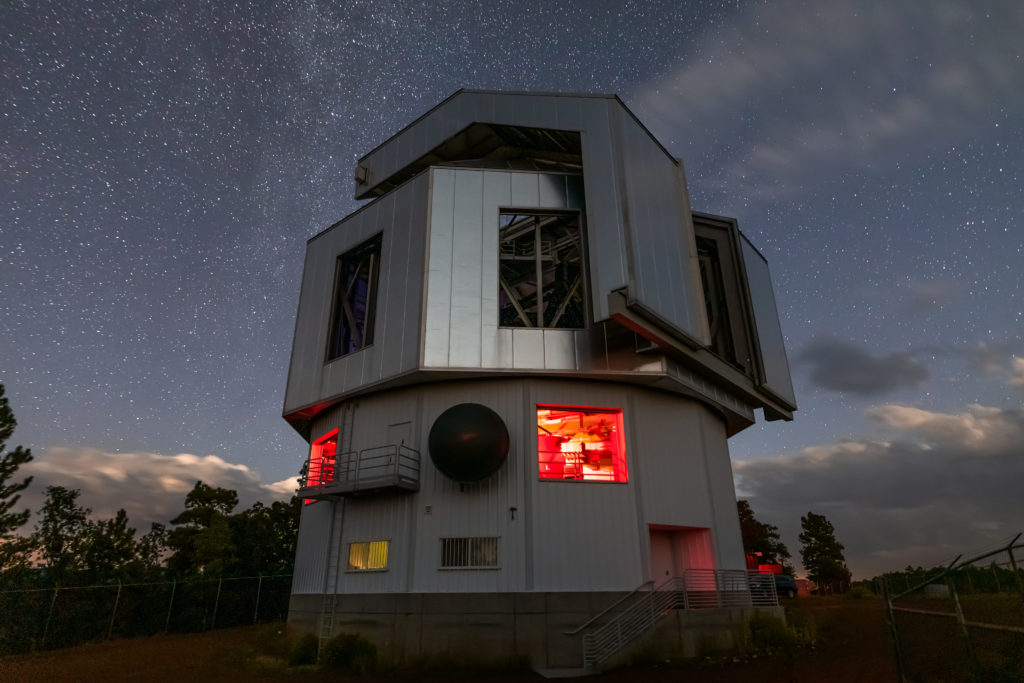
The 4.3-meter Lowell Discovery Telescope (LDT), Lowell Observatory’s flagship research instrument.
A Case for Curiosity: Why Publicly Funded Science Still Deserves Our Support
It’s easy to feel overwhelmed by the current state of things in our country. Budgets are shrinking, priorities are shifting, and scientific institutions across the country are left to make a case for why their research matters.
So, let’s take a moment to answer that question. Why does science matter?
The Value of Curiosity
Scientific progress doesn’t always begin with a blueprint. It often starts with a question – one that seems abstract at first, but later proves essential.
Basic research is how we got wireless communication, satellite weather forecasts, and even the digital cameras used in medical diagnostics. In many of these cases, the scientists who began the work had no idea where it would lead. But without that first step, the willingness to explore the unknown, we would not have the tools we now take for granted.
Centuries ago, an Italian chemist and physicist named Alessandro Volta became fascinated by electric eels. At the time, no one could have predicted where his research would lead. But his findings ultimately laid the groundwork for his invention of the battery, a technology that now powers everything from phones to pacemakers.
Curiosity-driven research also builds the foundation for applied science. Today’s theoretical discoveries become tomorrow’s technologies. A telescope designed to study galaxies ends up helping monitor container ships as they cross remote quarters of the ocean. A physicist studying light shapes your phone’s display.
“It’s important to just know about the universe we’re in,” says Dr. Gerard van Belle, the Director of Science and an astronomer at Lowell Observatory. “That curiosity is where all discovery begins, and it’s what helps us stay ready for the questions we haven’t thought of yet.”
From Theory to Technology
Volta’s battery is just one example. James Clerk Maxwell’s equations on electromagnetism led to the development of modern power systems. Einstein’s theory of relativity underpins the accuracy of the Maps app in your phone. Astronomy research in the 1980s and ’90s laid the groundwork for the digital cameras we rely on today, not only for photos, but also for medical imaging and remote sensing.
“In the pursuit of knowledge for knowledge’s sake, we find these very practical things,” says Dr. van Belle. “Einstein had no idea that 120 years later, people would be using his discoveries to have a pizza delivered to their door.”
Stories like these prove that curiosity is more than just an academic exercise; it’s the fuel that powers real innovation.
Why Space Science?
Among the most enduring questions science asks are the ones raised by space research. Are we alone in the universe? How did life begin? What else is out there? Are we safe?
While these questions may seem distant from daily life, they hold deep philosophical and cultural significance, and they often lead to very tangible benefits.
“It would be a civilization-defining discovery if we found life elsewhere,” Dr. van Belle explains. “It tells us a lot about ourselves. And even if we don’t find it, the difficulty of that search reminds us how rare and special life is – how much we should cherish it here on Earth.”
Astronomy may seem distant from everyday life, but its benefits reach much closer than most people realize.
Telescopes and satellites track objects that could impact Earth. Solar research helps protect satellites, GPS systems, and power grids from solar storms. Earth-observing instruments, many developed for space missions, now support weather prediction and climate science.
“Astronomy is how we stay one step ahead of the unknown,” says van Belle. “An asteroid won’t wait for a budget meeting.”
Here’s why this matters to everyone:
- Planetary defense: Astronomers monitor asteroids and comets that could threaten Earth.
- Space weather forecasting: Solar flares can disrupt power grids and satellite communications.
- Climate and Earth science: Space-based instruments help track wildfires, floods, hurricanes, droughts, and more.
- Technology development: Innovations from astronomy drive advances in sensors, imaging, and computing.
- Scientific literacy: Astronomy fosters curiosity and public engagement with science.
- Cultural and philosophical insight: The search for life beyond Earth reshapes how we understand our place in the universe.
Continued investment in astronomy ensures we can keep asking and answering the questions that matter, both for today and the future.
A Shrinking Margin
Despite its value, science – particularly federally funded research – is facing real challenges. Early-career scientists are struggling to find stable footing. Projects are being delayed or shelved. And while the impact may not be immediate, it will snowball.
“We may not see the effects right away,” says Dr. van Belle. “We’ll do just fine for the next ten years… But then we might not have a new antibiotic. We might need solar panels built elsewhere. And we’ll wonder when we lost our edge.”
The long timeline of scientific progress means today’s decisions won’t show their consequences until tomorrow. By then, it may be too late to recover what was lost.
“It does take a lot of effort to recreate what is so easy to destroy,” Dr. van Belle adds.
What You Can Do
While policy decisions are often out of the public’s hands, there are still ways to support science on an individual level:
- Stay informed about scientific research and why it matters.
- Support nonprofit science institutions through donations, memberships, or visits.
- Consider using resources from advocacy groups to engage with science policy.
“There’s real value in keeping the fire alive, even at a small scale,” Dr. van Belle says. “If you just keep a little bit of it burning, once the conditions are favorable again, you can start a bonfire pretty easily.”
Science matters. And supporting it now through curiosity, investment, or advocacy helps ensure a smarter, more prepared, and more wonder-filled future.
About Dr. Gerard van Belle
Director of Science

Stellar Astronomy/Instrumentation
PhD University of Wyoming, 1996
Dr. van Belle joined Lowell Observatory’s science staff in 2011 and is a tenured astronomer, and the Director of Science at the observatory. He is an internationally recognized expert in the design, construction, commissioning, and use of optical telescope arrays for carrying out astronomical observations at the highest levels of spatial resolution, including IOTA, PTI, Keck Interferometer, CHARA, VLTI-PRIMA and -MATISSE, and NPOI.
His award-winning astrophysical research projects have been pioneering in the fields of fundamental stellar parameters, stellar surface imaging, and characterization of exoplanet host stars. Dr. van Belle’s current research focuses on leaps in high-resolution capabilities with next-generation facilities such as the Big Fringe Telescope and the lunar-based MoonLITE project. At home he is a not-quite-incompetent homebrewer, and is restoring a vintage Stern Meteor pinball machine.
Check out Dr. van Belle’s webpage.