Meet the GODO Telescopes: 8” Moonraker Victorian Refractor
Written in collaboration with Claire Gibson & Hailey Osborn, Lowell Educators
Each of the Giovale Open Deck Observatory (GODO)’s six state-of-the-art telescopes were hand-selected to provide a breathtaking stargazing experience that is unrivaled by any other public observatory in the continental United States. In this blog series, we’ll be taking a deep dive into what makes each of the GODO telescopes the best of their kind.
Beauty and Brains
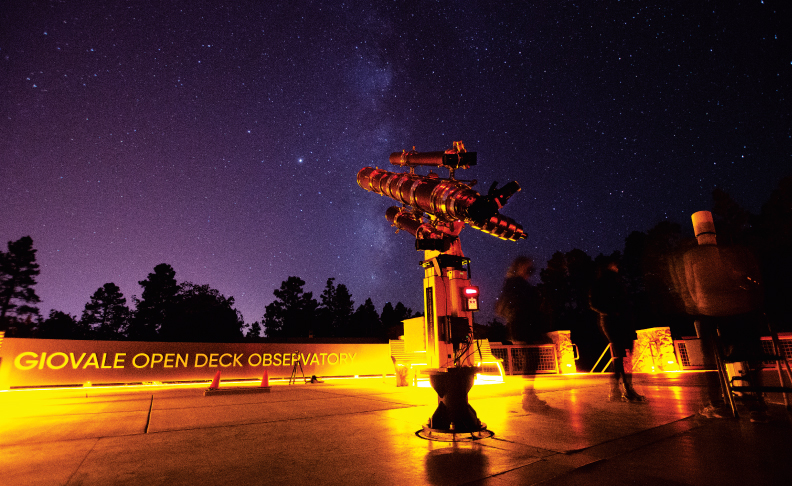
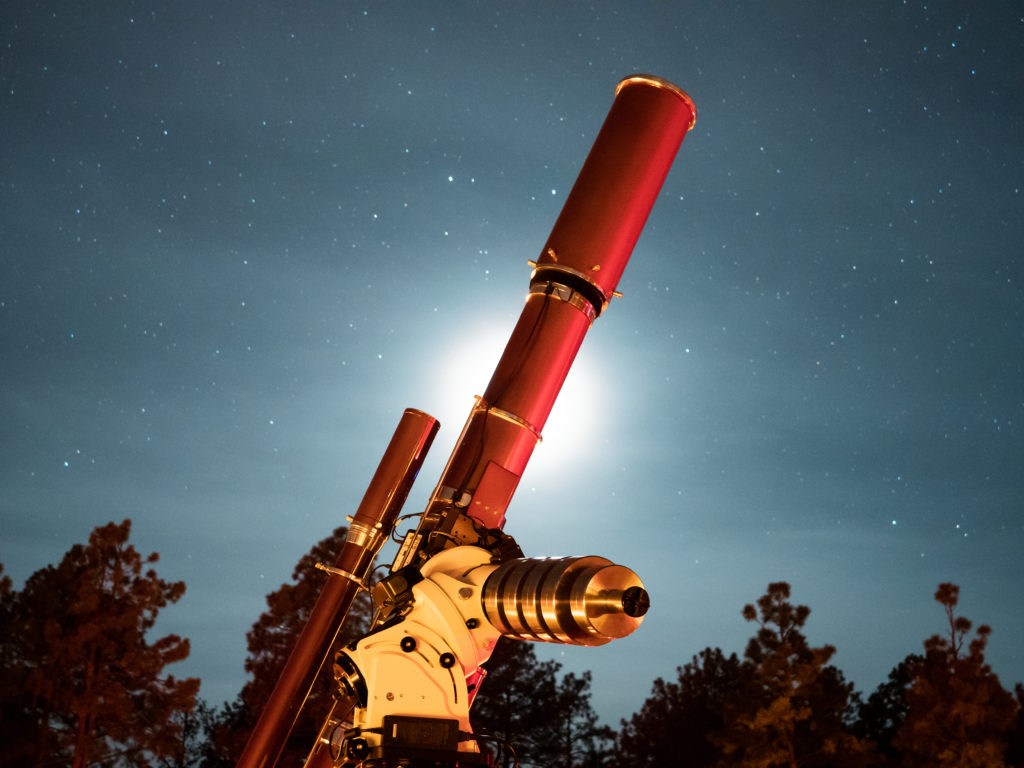
The 8” Moonraker Victorian Refractor is a stunning sight by day, and a treat to look through at night. A blend of Victorian styling and modern technology, its red and chrome Steampunk design echoes that of our 1896 24” Clark Refractor. Though its vivid coloring and pleasing design often make it a favorite among visitors, this telescope was built to offer much more than good looks.
Like the Clark, the Moonraker uses a superb two-lens design that results in outstanding, high-powered views of celestial objects. Planets like Mars, Jupiter and Saturn can be seen in crisp detail and color. Distant globular star clusters are resolved to their cores, giving them a three-dimensional effect. True to its name, the Moonraker is also an ideal instrument for observing the surface of the Moon, down to the structure of its craters.
The telescope is mounted on an articulating pier, which allows the height to be easily and quickly adjusted to allow comfortable viewing for all guests.
Telescope Specs
| Manufacturer | Moonraker Telescopes |
| Model | Custom build with doublet (achromatic) lens |
| Aperture | 203 mm (8 in) |
| Focal Length | 2436 mm |
| Focal Ratio | f/12 |
| Mount | Astro-Physics 1600 GTO |
About the Manufacturer: Moonraker Telescopes
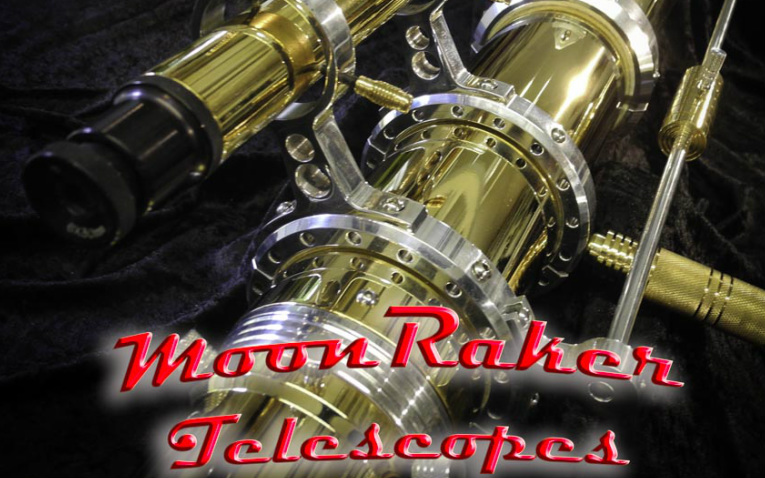
Moonraker Telescopes was founded by lifelong astronomy enthusiast Mark Turner in 2012. Today, the company works with international film, media, and publishing companies to create unique working telescopes and tripods. One of Moonraker’s telescopes appeared in Netflix’s Altered Carbon series (2018). If their presence in television in film wasn’t impressive enough, Moonraker also created a custom personal telescope for actor Tom Cruise that is plated in gold.
Each Moonraker telescope is built in-house in Middlesex, England. Every step in the design and manufacturing processes is completed by hand, giving the completed telescope a unique design, look, and quality.
Moonraker was the first telescope manufacturing company to use polished metal finishes, like gold and brass. Aesthetics are taken into account in every aspect of the telescope, including in its lens cap — the lip of the cap is given a contrasting color to that of the telescope itself, perfectly finishing off its design.
Each telescope is created differently in order to reflect the unique interest of the astronomer or observatory. The company certainly does not believe in a “one fits all” mentality!
More from the Blog
- PRESS RELEASE: New Study Reveals Big Compositional Shift In Small Near-Earth Asteroids
 Findings improve understanding of meteorite origins and impact-risk models. Flagstaff, AZ — A new study has highlighted a striking, size-dependent trend in the compositions of near-Earth asteroids (NEAs). By analyzing 189 NEAs, an international team of planetary scientists led by Dr. Nick Moskovitz of Lowell Observatory found that the smallest asteroids approaching Earth differ significantly… Read more: PRESS RELEASE: New Study Reveals Big Compositional Shift In Small Near-Earth Asteroids
 - What is Planetary Defense?
 What is Planetary Defense? The term “planetary defense” might sound like the stuff of science fiction. It conjures images of nervous scientists watching an encroaching asteroid on a grainy radar screen, a clock ticking down the seconds until a doomsday-bringing impact, or perhaps even tense negotiations between world leaders and hostile alien invaders. While these… Read more: What is Planetary Defense?
 - Bridging Stars and Storytelling with Nanibah Chacon
 In this episode of Star Stuff, Lowell Observatory historian Kevin Schindler sits down with renowned Diné (Navajo) and Chicana artist Nanibah Chacon. Following the unveiling of her breathtaking new mural at the observatory, Nanibah discusses the profound intersection of Indigenous culture, science, and public art.
 - The Little CubeSat That Could: SPARCS Captures First Light
 The Little CubeSat That Could: SPARCS Captures First Light After years of anticipation, the Star-Planet Activity Research CubeSat (SPARCS) has seen first light, sending its first round of ultraviolet images back to Earth on February 6, 2026. For Principal Investigator Dr. Evgenya Shkolnik and her collaborative team of students, researchers, and scientists — including Lowell’s… Read more: The Little CubeSat That Could: SPARCS Captures First Light
 - A Cosmic First: Comet Reverses its Spin
 A Cosmic First: Comet Reverses its Spin Astronomers have long known that comets are unpredictable, but now they are beginning to understand just how dramatically these dirty iceballs can change. New research shows that Comet 41P/Tuttle-Giacobini-Kresák not only slowed its rotation during its 2017 visit to the inner solar system but eventually reversed its spin… Read more: A Cosmic First: Comet Reverses its Spin