Partner Institutions
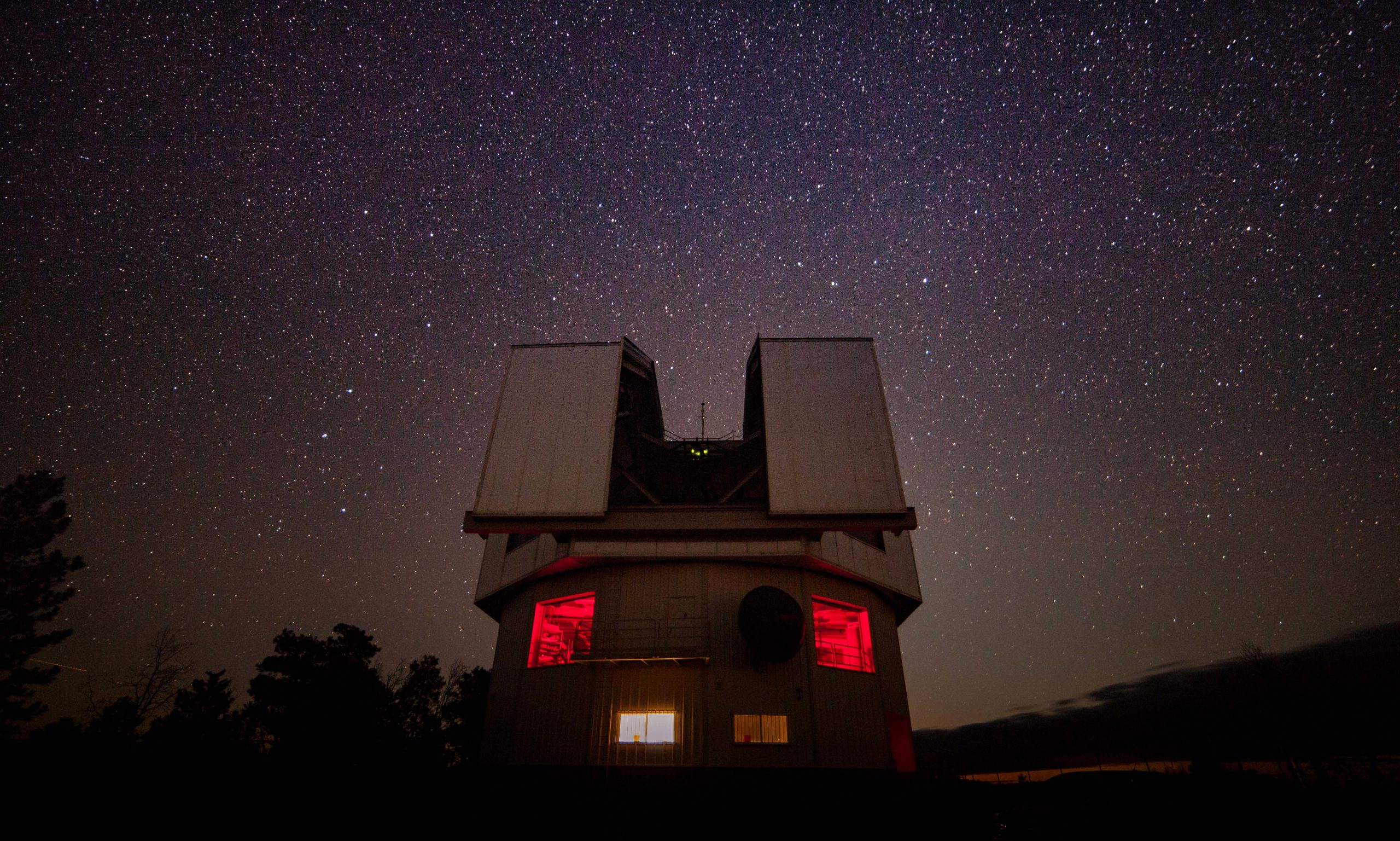
Lowell Observatory has formed scientific partnerships with a number of institutions, providing their researchers access to the Lowell Discovery Telescope and our facilities at Anderson Mesa.
LDT Partners
Learn About LDT
Boston University joined Lowell as a partner in 1998 on the 1.8-meter Perkins Telescope, an instrument which they have since acquired outright. In 2011, BU acquired access to the Lowell Discovery Telescope (LDT) through a major commitment that provides BU researchers access to the LDT for the lifetime of the facility. Faculty, research staff, and students from the BU astronomy department travel to Flagstaff regularly to use the LDT.

The University of Maryland, in partnership with the NASA Goddard Space Flight Center, acquired access to the LDT in 2011. Technicians from GSFC built the Rapid IMAGer Spectrometer (RIMAS). Astronomers from the University of Maryland’s Department of Astronomy use RIMAS and the LDT instrument cube’s fast instrument switching capability to perform follow-up observations of gamma-ray bursts.

The University of Toledo joined Lowell, Boston University, and the University of Maryland in 2013 as an LDT partner. Toledo astronomers use LDT for research on star formation and the evolution of star clusters.

Northern Arizona University joined the LDT partner group as of 2014. NAU scientists use the LDT for deep imaging of small objects in the solar system. Additionally, NAU partners with Lowell at our Anderson Mesa site both in the National Undergraduate Research Laboratory and in a new Near-Earth Object follow-up program.
NAU also manages the National Undergraduate Research Observatory, which provides access to Lowell’s 0.79-meter telescope for a consortium of four-year colleges around the country.

Yale University partnered with Lowell Observatory in 2015. Yale has a rich tradition in astronomy that goes back three centuries and is at the forefront of current astronomical research. Yale’s new instrument, the Extreme Precision Spectrometer (EXPRES), will search for Earth-like planets around other stars, as well as characterize the variations of the stars themselves, and is a welcome addition to LDT.
NPOI Partners
Learn About NPOI
Lowell Observatory partners with the Naval Research Laboratory (NRL) to operate the Navy Precision Optical Interferometer at Anderson Mesa. The interferometer serves multiple missions of precise stellar position measurements, imaging of satellites, and a number of astrophysical applications.

Lowell Observatory partners with the United States Naval Observatory (USNO) to operate the Navy Precision Optical Interferometer at Anderson Mesa. The interferometer serves multiple missions of precise stellar position measurements, imaging of satellites, and a number of astrophysical applications.